
Locked liquidity
When a launch graduates, everything its curve raised and the tokens it kept back go into its canonical pool as one liquidity position. That position is locked forever: nobody can withdraw it, including GAMA. This page explains what is locked, where to see it, and what the lock does and does not mean for you.
What goes in
At graduation, the curve hands over two things:
- the pair token it raised from buyers, net of fees: 7.8 ETH for a launch priced in ETH;
- the 220,000,000 tokens (22% of the supply) that the curve never sells, the liquidity allocation.
They become one Full range position in the launch's canonical pool, opened at the curve's last price. The position NFT goes straight to the locker, a contract that keeps it permanently. All of this happens in the same transaction as the buy that completes the sale. See Graduation.
For example, GAMA itself graduated on the current release in one transaction at block 37,694,055: the final buy, the new pool and the locked position are all in that one transaction.
Where to see it
On a graduated token's page, the side panel shows Locked liquidity: how much of each token the locked position holds, valued at the current pool price, not counting uncollected fees.
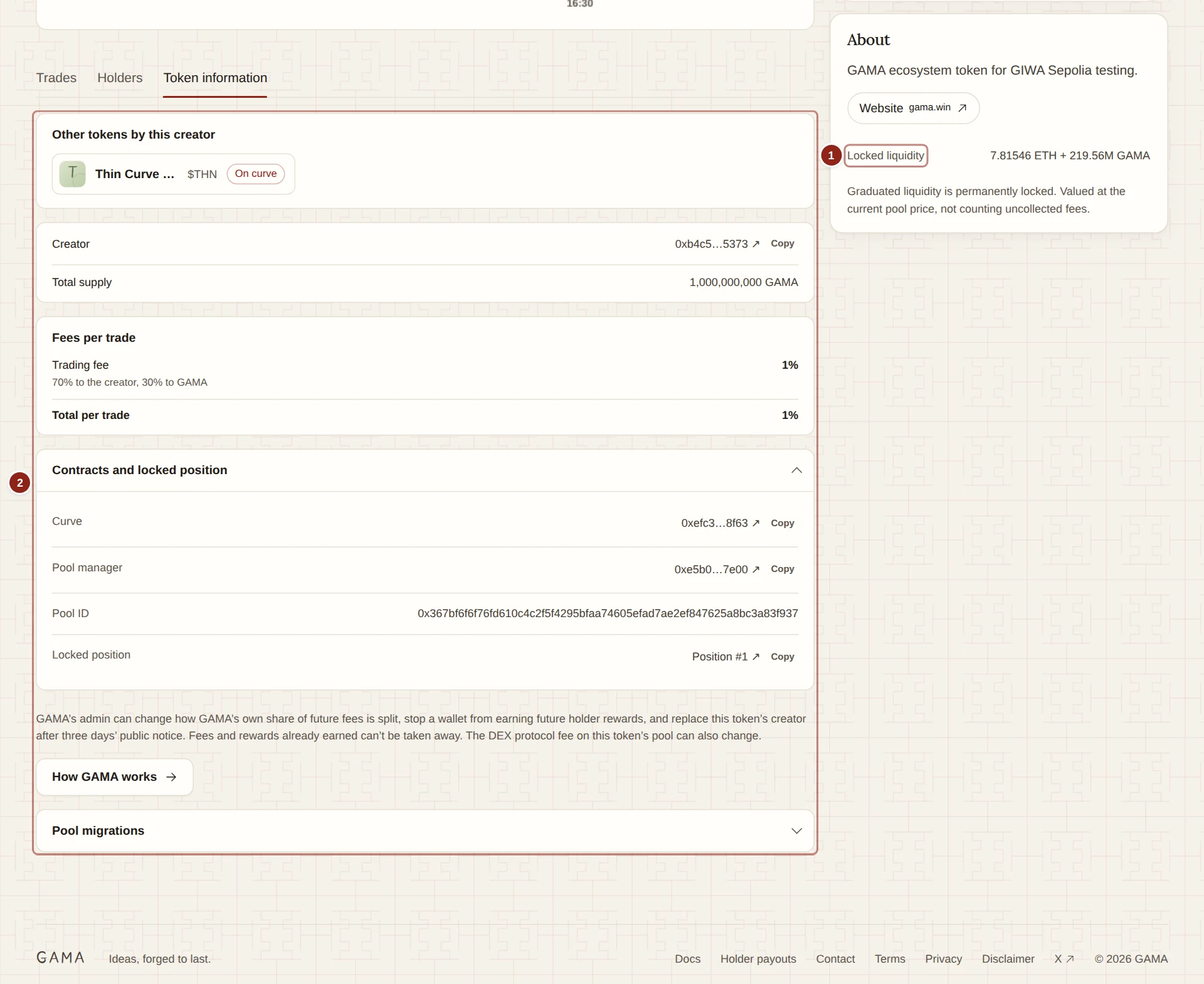
- Locked liquidity: the amounts held by the locked position, with the note "Graduated liquidity is permanently locked."
- Token information tab: under Contracts and locked position, the Curve, the Pool manager, the Pool ID and the Locked position with its number.
The pool's own page says the same in its Fee breakdown: "The liquidity added at graduation is locked forever. Liquidity added by other wallets is not locked."
What locked means
- No withdrawal. The locker has no way to withdraw the position, approve anyone to use it, or make any other call with it. The protocol owner cannot take it out either.
- No sweep. There is no emergency function that moves the funds elsewhere.
- One exception: migration. The protocol owner can move a launch's locked position to another approved trading venue. The move takes the liquidity out and locks the new position in the same transaction, at the same price; if any part fails, nothing changes. See Migration.
- Rounding leftovers. Creating the position can leave tiny amounts that do not fit into it. Leftover launch tokens stay locked with the position. Leftover pair tokens go to the protocol treasury.
What it does not mean
- The price can still fall. Locked liquidity means the pool always has both tokens, so you can always sell. It does not hold the price up. If holders sell, the price falls, and it can fall close to zero.
- It earns nothing for anyone. A canonical pool has no LP fee, so the locked position earns no trading fees. The launch's fees go to the creator, the holders and GAMA through the fee escrow instead.
- Other liquidity is not locked. After graduation anyone can add their own position to the canonical pool. That liquidity stays theirs and can be withdrawn at any time. Because the pool has no LP fee, it earns no trading fees either.
TIP
The locked position is full range, so the pool can be traded at any price. Even a token whose price has fallen far still has a pool to sell into.