
Buy limits
While a token is on its bonding curve, one buy can take at most 2% of the supply, and a wallet can hold at most 2% after a buy. The limits spread a new token across more holders. They end when the token graduates.
The two limits
| Limit | On the testnet | What it measures |
|---|---|---|
| Per buy | 2% of the supply, 20,000,000 tokens | The tokens one curve buy delivers |
| Per wallet | 2% of the supply, 20,000,000 tokens | The balance of the wallet that receives the tokens, after the buy |
A curve buy that would deliver more than 20,000,000 tokens, or leave the receiving wallet with more than 20,000,000, fails and changes nothing. On a fresh ETH launch, the first 20,000,000 tokens cost about 0.058 test ETH; later in the curve the same number of tokens costs more.
The token page lists the limits under Token information as Buy limits on the curve: "2% per buy · 2% per wallet".
How the trade panel shows them
When you buy on a curve, the Buy / Sell panel tells you how much room you have left:
- "You can buy up to 15.2M GARDEN more." Your wallet's room under the limit, as an example.
- "Reduced to your buy limit of …" when you choose an amount above your room, such as with Max.
- "Your wallet has reached this token's buy limit. You can still sell, and the limit ends when the token graduates."
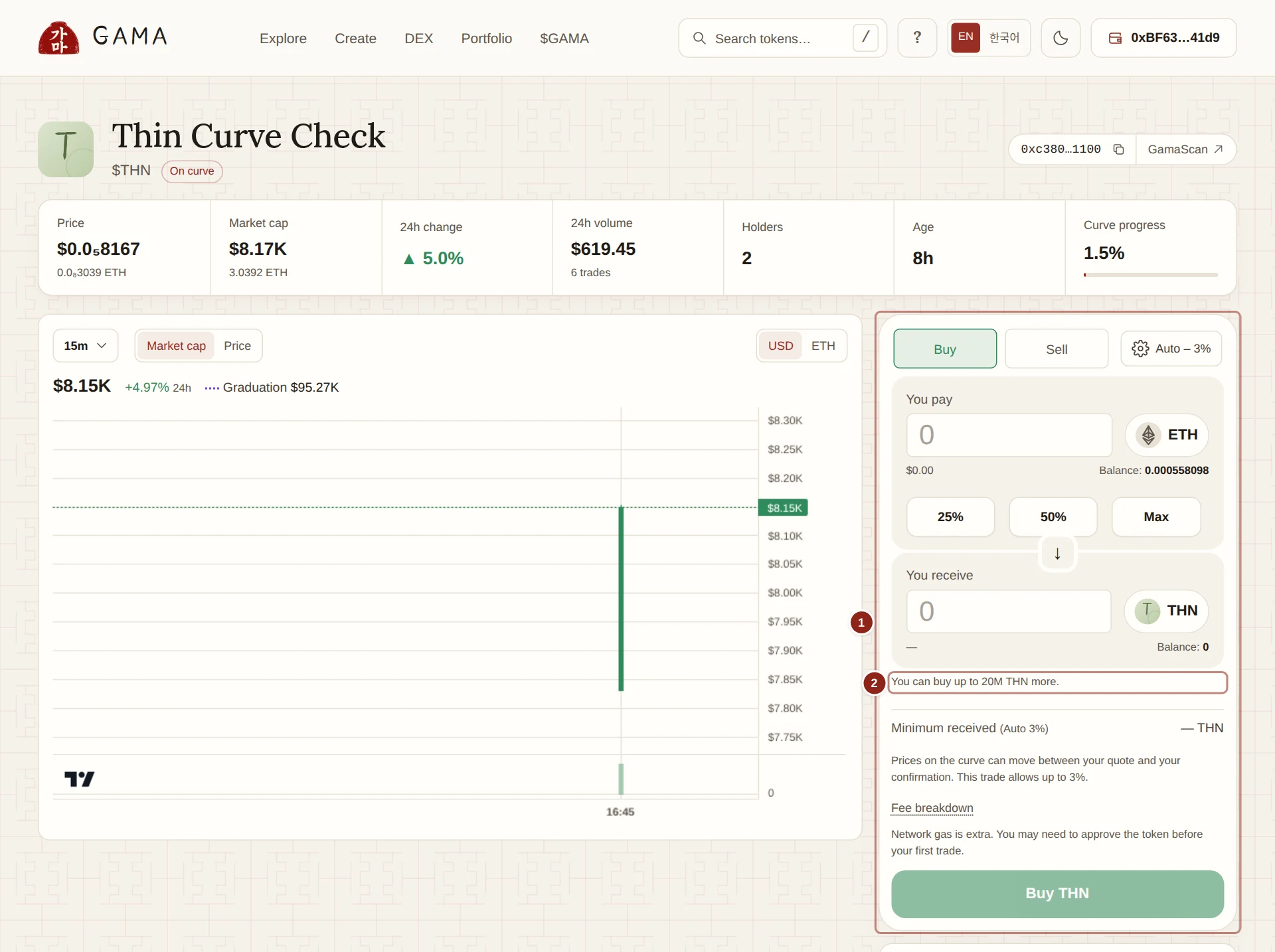
- Buy / Sell: the trade panel of a token on its curve.
- Buy limit: how many more tokens this wallet can buy on the curve.
How the limits are counted
- The receiving wallet counts, not the payer. The wallet limit measures the address that receives the tokens. Every token it already holds counts, however it got them.
- Only tokens actually delivered count. When a buy is larger than what is left on the curve, it buys only what is left and the rest of the payment is refunded. So a final buy within the limits still completes the sale and graduates the token.
What is never limited
- Selling on the curve.
- Sending or receiving tokens.
- Trading in the pool, and everything after graduation.
The token itself has no maximum wallet or transaction size. A transfer can leave a wallet above 2%; that wallet then cannot buy more on the curve until its balance is back under the limit.
Who sets them
GAMA's admin sets both limits for future launches. Each limit is either off, or between 0.5% and 100% of the supply, so no setting can stop ordinary buying. Each launch keeps the limits it was created with: neither its creator nor GAMA's admin can change them afterwards. The Token preview shows them before you launch, as Buy limits on the curve.
Exemptions
These purchases and wallets skip both limits:
- The initial buy. The creator's initial buy inside the launch transaction is exempt, whatever its size. The creator's later buys are limited like anyone else's.
- The GAMA buyback-and-burn. Its purchases of GAMA are burned in the same transaction. See Buyback and burn.
- The dead address, where burned tokens go.
- The exemption list. GAMA's admin keeps a list that applies to every launch of the release at once. It holds the app's swap routers and its order book, which buy on behalf of someone else and apply both limits to that person themselves: a router checks the wallet that sends the trade, and the order book checks each order's owner, also inside a batch of orders. On the current testnet release, the protocol owner's own address is on the list too.
The anti-snipe exemptions give no exemption from buy limits.
If a limit order or DCA order would take your wallet over the limit, the order waits and shows "Waiting: your wallet is at the buy limit". See Your orders.
Limits are per address
The limits apply to each address separately. They do not identify people: one person with several addresses can buy up to the limits with each of them. The limits slow down large early purchases; they do not stop them.