
Holder rewards
A reward-mode launch takes a holder fee of 1% to 4% on every trade and shares it among the token's holders, in the paired asset, from the very first trade. You earn by holding the token: there is no staking, no sign-up and no minimum balance.
Where the rewards come from
Every buy and every sell of a reward-mode token pays the holder fee, on the bonding curve and later in the pool. The creator chose the rate at launch, from 1% to 4%, and it never changes. The token page lists it under Token information, Fees per trade, as Holder rewards: "Shared by token holders". Reward-mode tokens carry a Reward mode tag.
Rewards are paid in the token's paired asset: holders of an ETH launch receive ETH.
For example, on a token with a 2% holder fee, a buy of 1 test ETH pays 0.02 test ETH to holders. If you held 10% of the earning supply at the start of that block, you earn 0.002 test ETH from that one trade.
Who earns
Every holder earns in proportion to the tokens they hold. These never earn:
- GAMA's own contracts that hold tokens, such as the bonding curve, the pool, the locker and the fee contract;
- the dead address, where burned tokens go;
- the curve of another launch that is priced in this token and holds it as its paired asset.
GAMA's admin can also stop a specific address from earning future rewards. What it has already earned stays claimable; the app then says "This wallet no longer earns new rewards from this token. You can still claim what it already earned." Addresses exempted from trading fees still earn like any holder.
Tokens waiting in your order vault earn too. You claim them there, under Vault rewards.
How rewards are counted
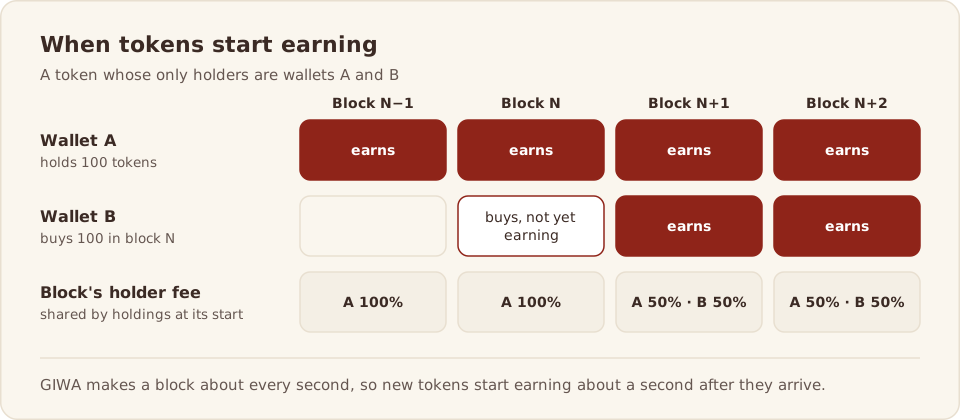
- New tokens start earning in the next block. Tokens you buy or receive earn from the block after they arrive. GIWA makes a block about every second.
- Your newest tokens leave first. When you sell or send part of your holding, the tokens that have not started earning go first, so your older holding keeps earning.
- Each block is shared by who held at its start. A block's holder fees are divided by the earning supply at the start of that block. If holders sell during the block, their part of that block's fees cannot go to anyone else and goes to GAMA instead. So holders do not always receive the whole holder fee.
- The launch block pays GAMA. In the block a token is created in, nobody holds it yet, so the whole holder fee of that block, including on the creator's initial buy, goes to GAMA.
- Earned is earned. Rewards you have earned stay yours after you sell all your tokens. They never expire.
Early holders
Early holders, including the creator's initial buy, receive most of the rewards while a token is on its curve. From the block after the first purchase, a sole early holder receives the whole holder fee from everyone else's trades. Its share falls only as later buyers' tokens start earning.
Trading with yourself to collect rewards always loses money. Every trade pays the trading fee, and you can win back at most your own share of the holder fee you paid.
WARNING
These rules stop the same-block tricks that were tested. They are not proven to stop every attack spread over several blocks.
Getting paid
- Automatically. GAMA pays holders about every five minutes. On an ETH launch, a payment happens once at least 0.0005 ETH would arrive, and it deducts a charge of the lower of 0.000001 ETH and 1%.
- By claiming. You can claim any time in Portfolio, under Rewards, with no charge and no minimum. You pay only the gas.
See Payouts and claims for the rules, and Your rewards for the screen.
If a token's liquidity has moved to a new pool (a migration), trades in the old pool still add to the same rewards. Before claiming you may be asked to bring them over first with Move from old pool. Anyone can do this step, and it costs only gas.